
Science Isn't Enough
A Case for the Humanities

“You have to know the past to understand the present.”
- Carl Sagan
Astronomer Carl Sagan understood that a long view across time was essential not only for understanding the cosmos, but humanity itself. This vantage point is one of the most powerful analytical tools we possess.
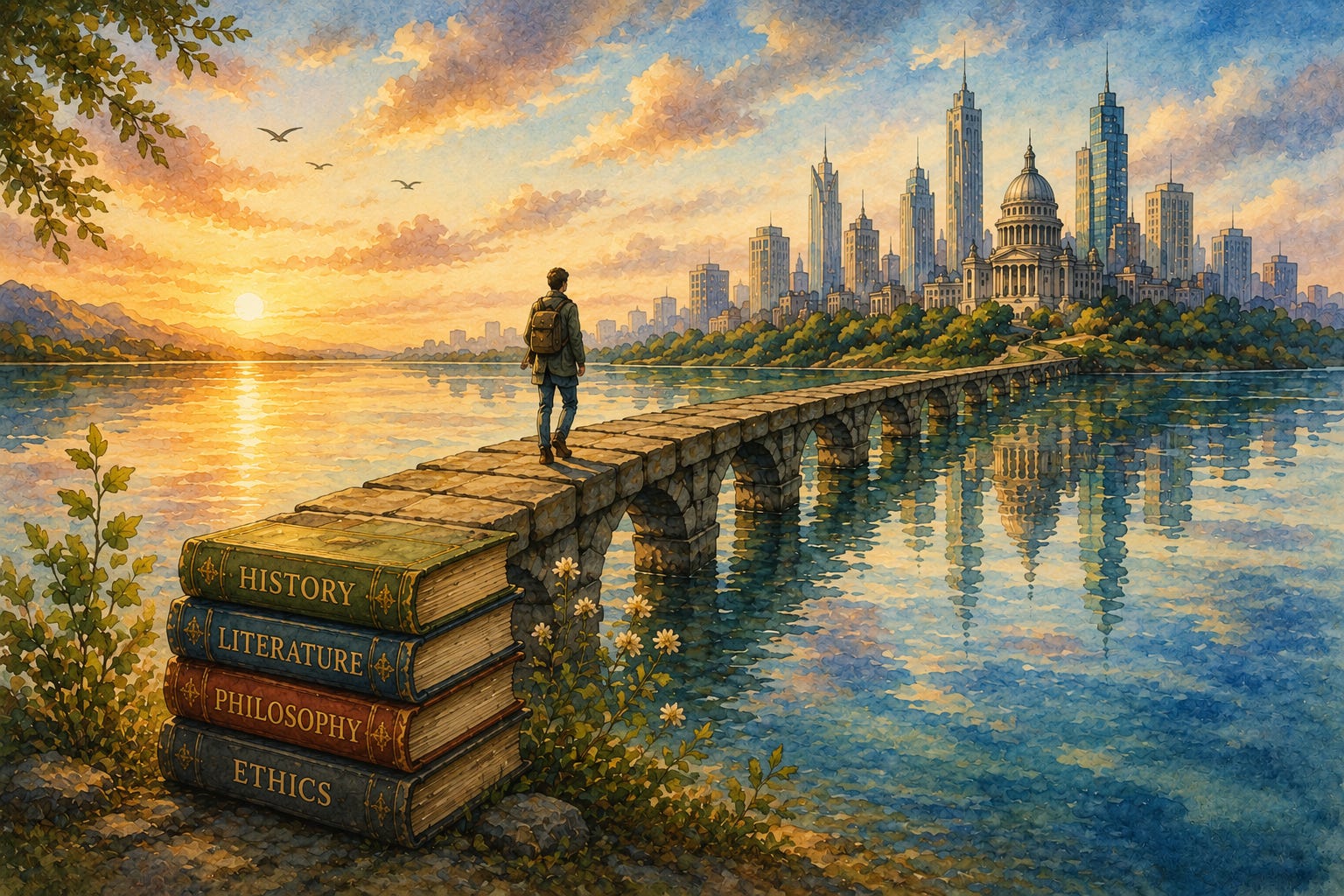
As an interdisciplinary scientist, I have deep roots in both biology and classical history. In college, I studied genetics and complex systems while also reading the works of Thucydides and Herodotus. Immersing myself in the past felt complimentary to my scientific training, offering thousands of years of perspective on innovation, leadership, conflict, and cultural transition.
Too often, science is portrayed as a collection of facts rather than an iterative process that evolves as we learn more about our world. Human societies change similarly over time as borders shift, empires rise and collapse, and entire social systems transform in ways their inhabitants rarely expect. It’s a mistake to assume that our own moment of existence is uniquely exempt from this pattern.
Absorbing the lessons of science and history together has fundamentally shaped how I interpret current events, political instability, and the technological revolutions now unfolding around us. A researcher who cannot locate the present moment within the longer human story is working with incomplete data.
Yet this broader perspective is increasingly undervalued. As universities shutter humanities programs and consolidate history departments, the argument that STEM fields are practical while everything else is distraction has gained enormous cultural traction. But it is arrogant to assume that disciplines devoted to understanding human behavior, political institutions, and ethics offer little return on investment.
Shrinking higher education budgets have increasingly favored fields with clearer market outcomes. But these decisions overlook the fact that analytical rigor and historical perspective are most powerful when integrated. Scientific literacy helps us understand what we can do. The humanities help us understand where we have been.
Writing in the fifth century BCE, Herodotos was explicit about why he sought to record his Histories. He wanted to chronicle what human beings had done so their deeds would not be forgotten. Herodotos understood that civilizations which lose their memory of how power is abused, how coalitions fracture, how prosperity breeds complacency, and how democracies weaken tend to relearn those lessons at extraordinary cost.
Many of the debates we consider modern aren’t unprecedented. The concentration of wealth and political influence in the hands of a small elite and its effect on civic life is not a new problem. The Roman Republic spent its final century wrestling with what happens when private wealth and public authority become impossible to disentangle. The anxiety surrounding AI and labor displacement echoes previous technology shocks, from the printing press to industrial mechanization to electrification. History does not dictate outcomes, but it can teach us about recurring pressures, risks, and opportunities.
Geopolitics is no different. The reordering of alliances, the risks of extreme hubris, and the strain on multilateral institutions are dynamics documented from Xerxes lashing the Hellespont to the Napoleonic settlements to the post-colonial transitions of the twentieth century. History reveals how escalating pressures can narrow choices, disrupt institutions, and reshape alliances.
“History is the only laboratory we have in which to test the consequences of thought.”
- Étienne Gilson, philosopher and historian
Scientists are trained to interrogate sources and weigh evidence. What is less common is applying that same rigor to the human record, to history, literature, and the accumulated experience of people across centuries.
The path to this moment was charted long before we arrived. Societies that understood this tended to contend with instability more successfully than those convinced they were living outside of history altogether. A civilization that abandons historical memory does not become more advanced or more rational, but easier to manipulate, to destabilize, and less capable of recognizing familiar dangers when they reappear in new forms.
In an age of rapid social, political, environmental, and technological change, the humanities are among the few tools we possess for distinguishing what is genuinely unprecedented from what we have forgotten. And they remain our most reliable compass for navigating the future.
the decline of humanities tho can be chalked up to the pivot toward fashionable deconstruction and politics in those fields to make them more "applied" and "practical" (praxis) rather than focus on their elevation of the eternal things and timeless beauty that knows no bounds of time or culture
Sing, Goddess, sing of the rage of Achilles, son of Peleus!